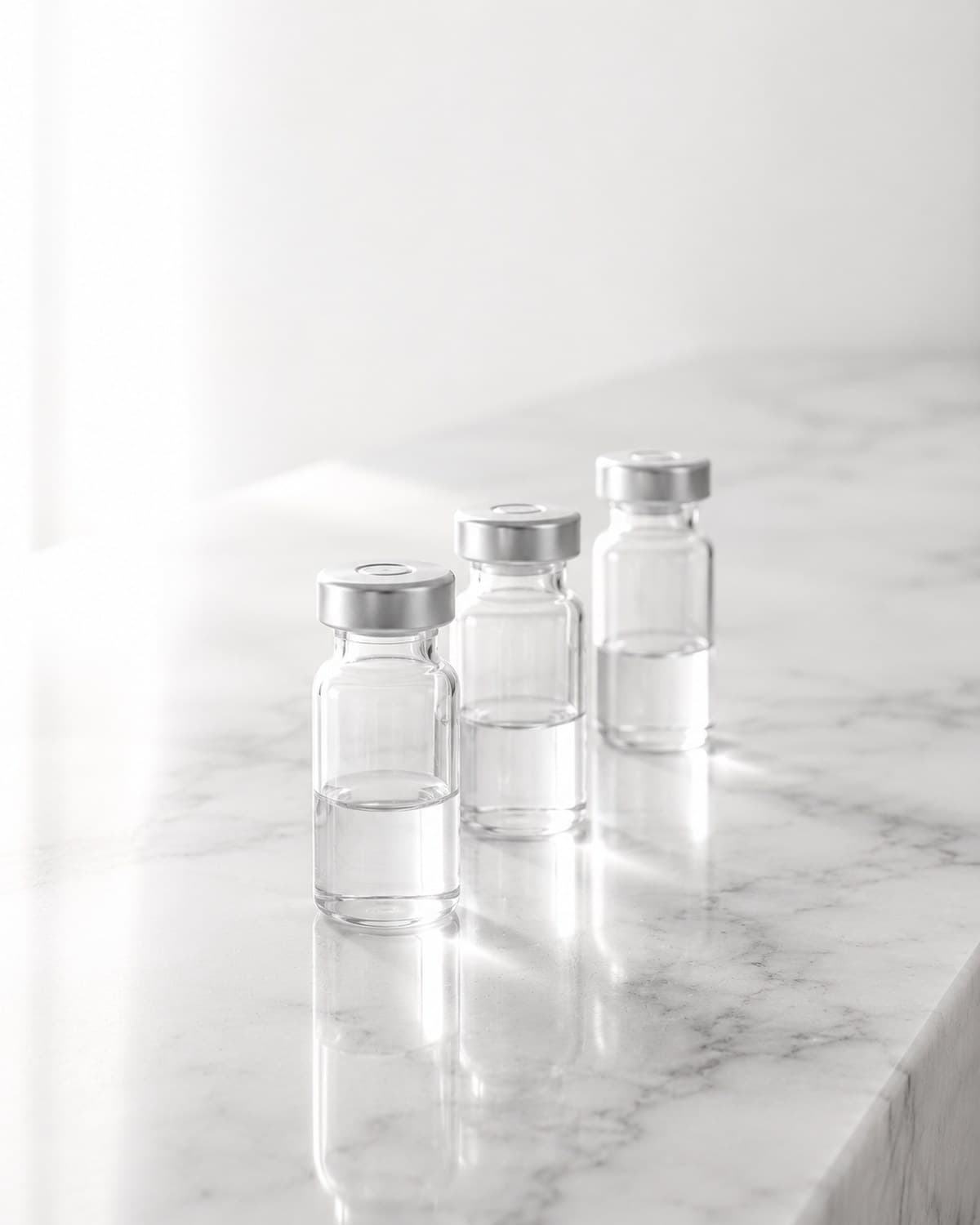
Why freeze-dry instead of storing in solution
Peptides in aqueous solution are intrinsically unstable. Water actively participates in the main chemical degradation pathways: backbone hydrolysis, deamidation of asparagine and glutamine residues, oxidation of methionine, cysteine, and tryptophan, and racemization. The 2023 Pharmaceutics review by Wang and colleagues identifies deamidation as the single most common chemical degradation route in peptides, with kinetics that depend on pH, temperature, and the residue adjacent to the labile site.
Lyophilization drops residual water content, typically below 1-3 % w/w. With no free water, hydrolytic reactions slow by several orders of magnitude, and the peptide can be stored for months or years at controlled temperature without measurable loss of purity by HPLC (high-performance liquid chromatography). That is why the lyophilized format became the de facto standard for research peptides and for many marketed biologics.
Inside the freeze-dryer
The cycle has three stages. First, freezing: the solution is cooled below its eutectic temperature or its frozen glass transition temperature (Tg'), trapping the peptide in a matrix of ice and concentrated solutes. Second, primary drying: chamber pressure is reduced below the vapor pressure of ice and gentle heat is applied through the shelves; ice converts directly from solid to vapor by sublimation, bypassing the liquid phase. This step is what avoids the mechanical stress that would otherwise wreck the cake architecture.
Secondary drying removes residual water bound to the amorphous matrix by desorption, at higher temperature and lower pressure. Keeping the product below the formulation's collapse temperature during primary drying is critical. Push the cycle too aggressively and the amorphous matrix flows; the cake collapses into a dense, glassy pellet that reconstitutes poorly and often correlates with potency loss.
When the cycle is well-designed, the output is an elegant cake: porous, white to off-white, occupying roughly the original liquid volume and dissolving in seconds. A shrunken, vitreous, or melted cake is a visible signal that something in the cycle or the formulation went wrong.
Excipients: mannitol, trehalose, and what each one does
Peptides are almost never lyophilized neat. The mass per vial, typically under 10 mg, is too small to form a visible cake, and the molecule needs protection against process stress. Excipients serve two complementary roles: bulking (building structure) and lyoprotection (stabilizing the molecule through freezing and drying).
Trehalose is the workhorse lyoprotectant for peptides and proteins. It is a non-reducing disaccharide that, under the water replacement hypothesis, substitutes for hydrogen bonds water previously formed with polar groups on the peptide surface, preserving conformation. Trehalose also forms a high-Tg amorphous matrix that suppresses molecular mobility during storage. A 2024 PMC review on lyoprotectants describes trehalose as particularly robust against freeze cycles because it resists crystallization.
Mannitol plays a different role. It crystallizes during freezing and supplies the mechanical scaffold that holds the cake together. Formulations that combine mannitol (typically the dominant mass) with a critical fraction of trehalose tend to produce cakes that are both elegant and mechanically solid, without sacrificing lyoprotection.
Shelf life in the dry state: -20 °C, 4 °C, and room temperature
Solid-state stability depends on three variables: residual cake moisture, storage temperature, and the formulation's Tg. The practical rule from the literature is straightforward: the further below Tg the peptide is stored, the lower the molecular mobility and the longer the shelf life. For most well-lyophilized research peptides, that translates into observed stability of multiple years at -20 °C, on the order of 12 to 24 months at 2-8 °C, and months at ambient temperature for unusually robust sequences.
These ranges are indicative, not guarantees. A peptide with exposed methionine can oxidize even in the solid state if residual oxygen sits in the vial headspace; an Asn-Gly motif can deamidate even in a dry matrix. Real stability data come from HPLC and mass spectrometry runs under accelerated conditions (40 °C / 75 % RH) and at nominal temperature over time, not from theoretical extrapolation.
Practical default for research labs: -20 °C for unopened lyophilized material, in a freezer without an automatic defrost cycle. Frost-free units add thermal swings that vials do not appreciate.
Reconstitution and post-reconstitution handling
Once reconstituted, the peptide is back in aqueous solution, and the hydrolytic chemistry that lyophilization paused starts running again. The most common diluent for research use is bacteriostatic water (BAC water), which contains 0.9 % benzyl alcohol as a preservative. Pharmaceutical literature documents reconstituted shelf life of up to 20 days at 2-8 °C with bacteriostatic water, compared with shorter windows for preservative-free sterile water.
Saline and sterile water are valid alternatives but neither prevents microbial growth once the stopper has been pierced. For peptides with basic groups sensitive to benzyl alcohol, diluent choice should be verified on a per-sequence basis.
The most expensive handling mistake is the repeated freeze-thaw cycle. Each cycle exposes the peptide to mechanical stress from ice crystal formation, to local pH changes from cryoconcentration of buffer salts, and to an ice-liquid interface where peptides and proteins preferentially aggregate. Standard practice is to aliquot the reconstituted solution into single-use volumes before the first freeze, store aliquots at -20 °C or -80 °C, and thaw each one exactly once.
What to look at before accepting a vial
Research labs that take incoming peptide deliveries benefit from a short audit before the material enters an experiment. Visual cake inspection (elegant versus collapsed or melted), a certificate of analysis with HPLC purity and mass spectrometry confirmation, and documentation of the freeze-drying cycle are baseline quality signals.
In 2026, as the research-use-only peptide market matures, transparency on formulation, which excipients are in the vial and in what proportion, is becoming a differentiator. A clearly declared trehalose-plus-mannitol matrix is preferable to an opaque cake, because it lets the user predict reconstitution behavior and set sensible storage expectations.
Key takeaways
- Lyophilization removes free water by sublimation, slowing the hydrolytic pathways (deamidation, hydrolysis, oxidation) that degrade peptides in solution.
- Trehalose acts as a lyoprotectant (replacing water hydrogen bonds and forming a glassy matrix); mannitol provides crystalline bulking that holds the cake structure.
- Sealed vials store longest at -20 °C in a non-frost-free freezer; 2-8 °C is reasonable short-term and room temperature is for transit only.
- Reconstituting with bacteriostatic water (0.9 % benzyl alcohol) buys multi-day stability at 2-8 °C; sterile water and saline give shorter windows.
- Aliquot before the first freeze and thaw each aliquot once. Repeated freeze-thaw cycles accumulate aggregation and chemical loss.
Sources consulted
- Designing Formulation Strategies for Enhanced Stability of Therapeutic Peptides in Aqueous Solutions: A Review (Pharmaceutics, MDPI)
- Effectiveness of Lyoprotectants in Protein Stabilization During Lyophilization (PMC)
- Practical advice in the development of a lyophilized protein drug product (PMC)
- Factors affecting the physical stability (aggregation) of peptide therapeutics (PMC)
- Storage and Lyophilization of Pure Proteins (PubMed)
This article describes findings published in the scientific literature. The products referenced are EXCLUSIVELY for scientific and laboratory research. They do not constitute a medical recommendation or therapeutic claim.