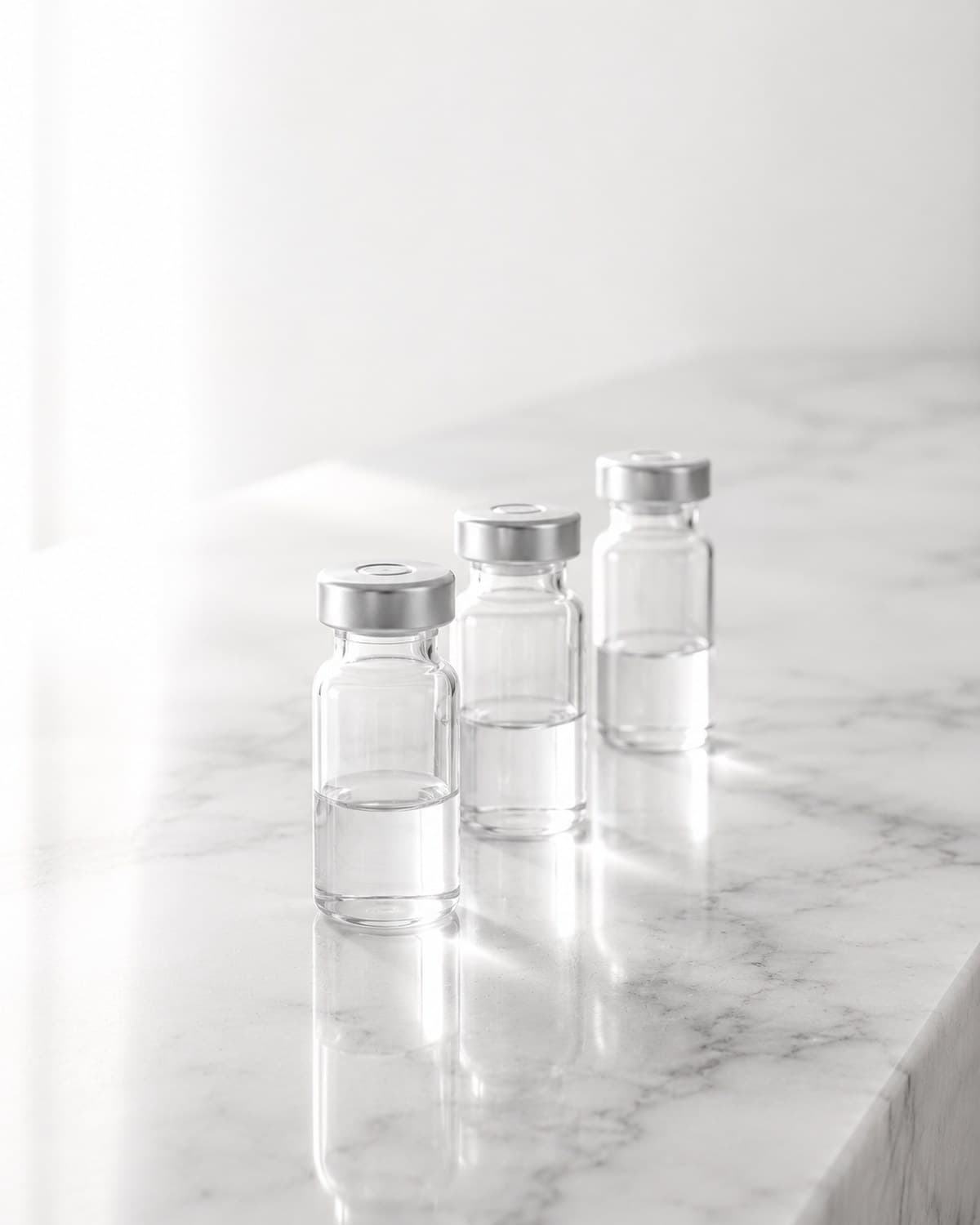
Why water is the most reactive reagent in the vial
Reconstitution is not a neutral step. The instant a peptide meets water, it starts reacting with three species that were absent in the solid: protons, hydroxide, and dissolved oxygen. Peptide-bond hydrolysis, asparagine and glutamine deamidation, and oxidation of sulfur-containing or aromatic residues are all spontaneous; temperature only sets the rate. What takes years in the lyophilized state can happen in days in solution.
The hot spots are well mapped. Asp-Pro is notoriously labile under acidic conditions because protonated proline is a competent leaving group, favoring a cyclic imide intermediate and chain cleavage. Asn-Gly, Asn-Ser, and Asp-Gly are deamidation and isomerization centers via the succinimide pathway, generating isoaspartate. These are not trivia: a classic study on growth hormone-releasing factor reported 25- and 500-fold drops in bioactivity for the aspartyl and isoaspartyl forms, respectively.
Oxidation: the invisible enemy of Met, Cys and Trp
Methionine, cysteine, and tryptophan are the residues most vulnerable to oxidation. The thioether on Met oxidizes readily to sulfoxide under acidic conditions or with trace metals; Cys forms unwanted disulfides or sulfenic acid; Trp can degrade to kynurenine via radicals. The process is pushed by UV light, dissolved oxygen, and Fe(III) or Cu(II) contamination from water or glassware.
Mitigations are specific. For cysteine-rich peptides at the bench, reducing thiols like DTT (dithiothreitol) or β-mercaptoethanol belong in working buffers, not storage buffers. To shield methionine, recent work shows free L-methionine above 20 mM acts as a sacrificial antioxidant, and the combination with 200 mM trehalose improves stability in high-concentration formulations. Chelators such as EDTA or DTPA control metal-catalyzed oxidation without introducing reactive products of their own.
pH, temperature, ionic strength: the three levers
pH decides which reactions dominate. Acid-catalyzed hydrolysis hits Asp-containing peptides hardest; Asn deamidation runs faster at neutral-to-basic pH via succinimide; Met oxidation accelerates under acidic conditions. For most research peptides, the minimum-degradation window sits between pH 4 and 6, though every sequence has its own optimum. A buffer study reported that at 40 °C deamidation was faster in acidic media, while at 5 °C the trend reversed because of how hydroxide concentration shifts with buffer and temperature.
Temperature follows roughly Arrhenius behavior: each 10 °C drop slows chemical degradation by a factor of two to four. That is why the gap between 25 °C, 4 °C, and -20 °C is operationally enormous. Ionic strength has a subtler role: it buffers electrostatic aggregation in highly charged peptides, but very concentrated buffers can also push succinimide cycles. A practical rule: keep buffers dilute (10-50 mM) and avoid phosphate when anion-catalyzed reactions are suspected.
Aggregation and adsorption: losses HPLC may miss
Not every loss is chemical degradation. Aggregation — dimers, soluble oligomers, insoluble fibrils — can consume active material without producing peaks visible by HPLC (high-performance liquid chromatography) if aggregates precipitate or stick to the filter. Hydrophobic peptides, β-sheet–prone sequences, and those with consecutive aromatic residues are most affected. The Royal Society Interface Focus review identifies concentration, pH near pI, and mechanical agitation as the main drivers.
Surface adsorption to polypropylene and glass is another classic sink, especially below 10 µg/mL. Additives like Tween-20 at 0.005-0.01 %, a BSA carrier, or pre-coating the tube with the peptide itself reduce these losses. For long-term storage, lyophilization with cryoprotectants (trehalose, sucrose) remains superior to refrigerated solution.
Practical shelf life after reconstitution
Operational guidelines from technical literature and supplier handbooks converge on reasonable starting numbers, not laws: roughly 24 hours at 25 °C in aqueous buffer, up to 7 days at 2-8 °C, and on the order of 30 days at -20 °C in aliquots. These are starting points; a peptide carrying Asp-Pro or Asn-Gly may visibly degrade sooner, while a sequence without sensitive residues can hold longer.
Freeze-thaw cycling is the most undervalued factor. Each cycle introduces osmotic and mechanical gradients that can denature and aggregate the molecule; technical reports describe 20-50 % activity losses per cycle for sensitive peptides. The standard practice is to aliquot into single-use volumes before freezing and discard the remainder rather than refreeze. The only rigorous way to validate the real shelf life of a specific compound is an in-house stability study with HPLC or LC-MS at defined timepoints.
Operational checklist for 2026 research
Before reconstituting, scan the sequence and flag sensitive residues: Met, Cys, Trp, Asn-Gly, Asp-Pro. That list decides the buffer (pH 4-6 when nothing contraindicates), the need for an antioxidant (free L-Met or EDTA when Met or trace metals are in play), and the storage format. For dose-response work where reproducibility matters, using fresh aliquots from the same lot and discarding the stock after the defined window is cheaper than repeating the assay.
These parameters are preclinical findings and in vitro observations aimed at bench research. They are not clinical or therapeutic guidance; the peptides discussed are handled as Research Use Only, and the quantitative numbers cited come from specific model peptides and are not universal.
Key takeaways
- Solution-phase degradation is dominated by hydrolysis (worst at Asp-Pro), deamidation (Asn-Gly, Asn-Ser) and oxidation (Met, Cys, Trp); temperature only sets the rate.
- pH 4-6 minimizes chemical degradation for most research peptides, but Asn deamidation accelerates at neutral-basic pH through the succinimide pathway.
- Useful antioxidants: free L-methionine above 20 mM, EDTA/DTPA for metal chelation, DTT or β-mercaptoethanol only in working buffer when Cys is present.
- Typical post-reconstitution window: ~24 h at 25 °C, ~7 days at 4 °C, ~30 days at -20 °C; treat as starting points, not universal numbers.
- Each freeze-thaw cycle can cost 20-50 % of activity; aliquoting up front is the highest-leverage move in the workflow.
Sources consulted
- Designing Formulation Strategies for Enhanced Stability of Therapeutic Peptides in Aqueous Solutions (PMC10056213)
- Asparagine Deamidation Dependence on Buffer Type, pH, and Temperature — Pace et al., J Pharm Sci
- Factors affecting the physical stability (aggregation) of peptide therapeutics — Interface Focus, Royal Society
- Effect of Methionine Sulfoxide on the Synthesis and Purification of Aggregation-Prone Peptides (PMC8252385)
- PubMed search: peptide stability hydrolysis oxidation deamidation
This article describes findings published in the scientific literature. The products referenced are EXCLUSIVELY for scientific and laboratory research. They do not constitute a medical recommendation or therapeutic claim.