Performance Platform
Three receptors.One single peptide.Retatrutide.
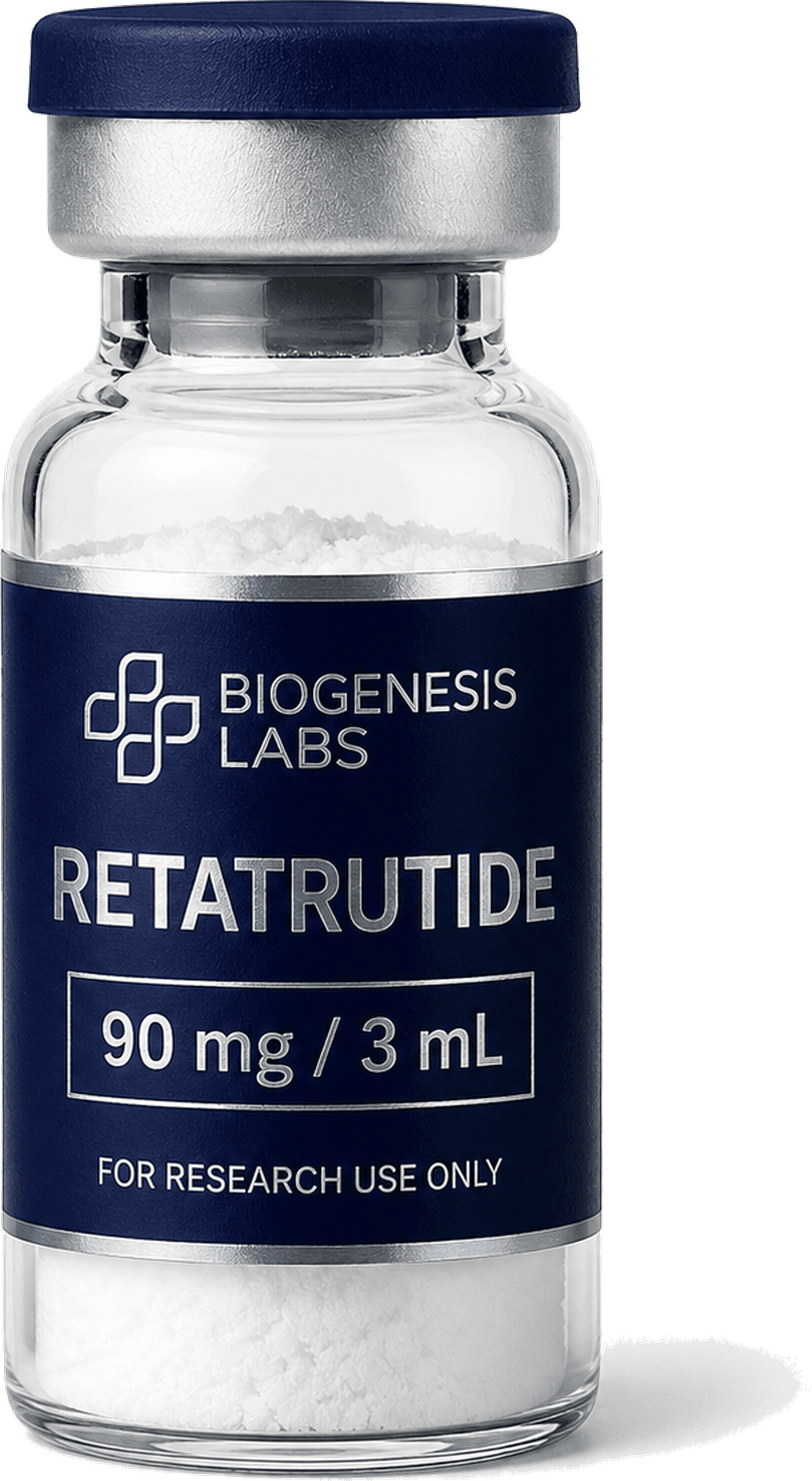
Retatrutide (LY3437943) is a synthetic lipidated peptide described in the literature as the first triple agonist of its class at the GIP, GLP-1 and glucagon receptors. It is an investigational compound: not approved by any regulatory agency. Biogenesis Labs supplies it as a reference material for in vitro and preclinical research.
Origin of the compound
Engineered toactivate three pathwaysat once.
Retatrutide was developed by Eli Lilly and Company under the code LY3437943. The literature describes it as a first-of-its-class triple receptor agonist: where there were once single-receptor agonists and later dual co-agonists, retatrutide brings a third axis — the glucagon receptor — inside a single molecule. The sponsor appears as the funder of every trial published to date.
Structurally it is a 39-amino-acid peptide conjugated to a C20 dicarboxylic fatty acid moiety, described in the publications as a continuous helical structure. In 2024, a paper published in Cell Discovery used cryo-electron microscopy to resolve the peptide's complexes with GLP-1R, GIPR and GCGR. The exact molecular weight and the full amino acid sequence were not published in the sources reviewed: Biogenesis neither asserts nor estimates them.
The point that organizes everything else: retatrutide is not approved by the FDA, the EMA, ANMAT or any other agency. It has no authorized indication, no prescribing information and no pharmacopeial monograph. All published efficacy comes from phase 2 trials with modest sample sizes and horizons of 24 to 48 weeks. The phase 3 programs — TRIUMPH in obesity, obstructive sleep apnea and knee osteoarthritis, and TRANSCEND-T2D-1 in type 2 diabetes — are under way.
Structural and historical data taken from peer-reviewed literature and public trial registries. Retatrutide is an investigational compound, not approved in any jurisdiction. Biogenesis Labs material is for in vitro and preclinical research: not for human consumption.
- 3
- Target receptors: GIPR, GLP-1R and GCGR
- 39 aa
- Peptide conjugated to a C20 fatty diacid
- Phase 3
- Programs under way. Compound not approved
- ≈6 days
- Mean half-life reported in the literature
Active research areas
Where the compoundis being studiedtoday.
Obesity — published phase 2 and registrational program
In the phase 2 trial published in The New England Journal of Medicine in 2023 (Jastreboff et al., n = 338 adults, 48 weeks, funded by Eli Lilly), a dose-dependent percentage change in body weight was reported: −8.7% at 1 mg, −17.1% at 4 mg, −22.8% at 8 mg and −24.2% at 12 mg, against −2.1% in the placebo group. The journal's accompanying editorial framed its title as an open question, not as a conclusion. The phase 3 registrational program TRIUMPH is under way and covers obesity, obstructive sleep apnea and knee osteoarthritis.
Findings published in clinical trials conducted and funded by the developer, cited for academic purposes. They are not an indication of use, nor a claim about the research material supplied here.
Type 2 diabetes — phase 2 in The Lancet, phase 3 under way
In the phase 2 trial published in The Lancet in 2023 (Rosenstock et al., n = 281 randomized, with placebo and dulaglutide 1.5 mg as an active comparator), the primary endpoint was change in HbA1c at 24 weeks. At 36 weeks, an HbA1c change of −0.43% to −2.02% by dose was reported, against −0.01% on placebo, and a body weight change of −3.19% to −16.94%, against −3.00% on placebo. Mild-to-moderate gastrointestinal events were reported in 35% of treated participants, with no severe hypoglycemia and no deaths. The phase 3 trial TRANSCEND-T2D-1 was published in The Lancet in 2026.
Figures reported in peer-reviewed literature, with sponsor funding. They are cited as scientific background, not as a property of — or an expected result from — the research material supplied.
MASLD — the strongest signal in the phase 2a
In the phase 2a trial published in Nature Medicine in 2024 (Sanyal et al., n = 98 randomized, 48 weeks, MASLD defined as ≥10% liver fat by MRI-PDFF), a relative reduction in liver fat content at week 48 was reported: −51.3% (1 mg), −59.0% (4 mg), −81.7% (8 mg) and −86.0% (12 mg), against −4.6% on placebo. Normalization, defined as liver fat below 5%, was reported in 89% of the 8 mg group and 93% of the 12 mg group. The authors reported no signal of hepatotoxicity; transient gastrointestinal events were the most frequent.
Results from an exploratory phase 2a trial with a small sample, cited from the original publication. They do not imply established efficacy and do not support any use of the material outside the laboratory.
Preclinical — metabolic oncology and cardiac pharmacology
Outside the clinical program, the 2025 literature includes preclinical work on obesity-associated cancer progression published in npj Metabolic Health and Disease, along with studies in direct cardiac pharmacology: inotropic effects in isolated human and murine atrial preparations. That line matters because the heart rate increase observed in the clinical trials remains an unresolved safety area. It is also the ground where research material has its legitimate place: in vitro and preclinical models.
Exploratory research in in vitro and animal models. Preclinical findings do not translate to humans. Biogenesis Labs material is supplied solely for experimental work of this kind.
Molecular mechanism
Three receptors.One and the samesecond messenger.
Retatrutide acts on three class B G protein-coupled receptors, the secretin family: GIPR (glucose-dependent insulinotropic polypeptide), GLP-1R (glucagon-like peptide 1) and GCGR (glucagon). In cAMP assays on transfected cells, distinct potencies were reported for each axis: EC50 of 0.0643 nM at GIPR, 0.775 nM at GLP-1R and 5.79 nM at GCGR. The profile described in the literature is more potent at the GIP receptor and less potent at the GLP-1 and glucagon receptors.
Activation of all three receptors converges on a single point: it increases adenylate cyclase activity, raises intracellular cAMP and activates protein kinase A pathways. The structures of the three receptor–retatrutide complexes, resolved by cryo-EM, describe the triple agonism as a combination of shared interactions with conserved residues and variable contacts specific to each receptor, located mainly in the upper half of the transmembrane domain pocket.
On the pharmacokinetic side, the literature reports a mean half-life of approximately 6 days, a Tmax of 12 to 72 hours, dose-proportional pharmacokinetics and hepatic metabolism with no interaction with cytochrome P450 enzymes. Lipidation with the C20 fatty diacid is the structural element associated with that prolonged half-life. Data on β-arrestin, receptor internalization or signaling bias were not published in the sources reviewed and are therefore not asserted.
Recognition and binding at all three receptors
The lipidated peptide seats itself in the transmembrane domain pocket of GIPR, GLP-1R and GCGR. It maintains shared contacts with residues conserved across the three receptors and accommodates variable contacts specific to each one, according to the structure resolved by cryo-EM.
Adenylate cyclase activation
Occupancy of each receptor increases the activity of the associated adenylate cyclases. This is the step measured in cAMP assays on transfected cells, which is where the EC50 values reported for each of the three axes come from.
cAMP elevation and the PKA pathway
The rise in intracellular cAMP activates protein kinase A-dependent pathways. All three receptors converge on this same cascade, with distinct potencies: the resulting signal depends on which of the three axes dominates at any given concentration.
Persistence conferred by C20 lipidation
The C20 dicarboxylic fatty acid moiety is the structural element the literature associates with the prolonged half-life of approximately 6 days reported in the trials, with a Tmax of 12 to 72 hours and dose-proportional pharmacokinetics.
Mechanistic description taken from peer-reviewed literature: cAMP assays in transfected cell lines and cryo-EM structures. It is an academic framework, not a description of effects in people. Retatrutide is not approved. The material is supplied for in vitro and preclinical use only.

Specifications
What is inside the vial
- Name
- Retatrutide (LY3437943)
- Presentation
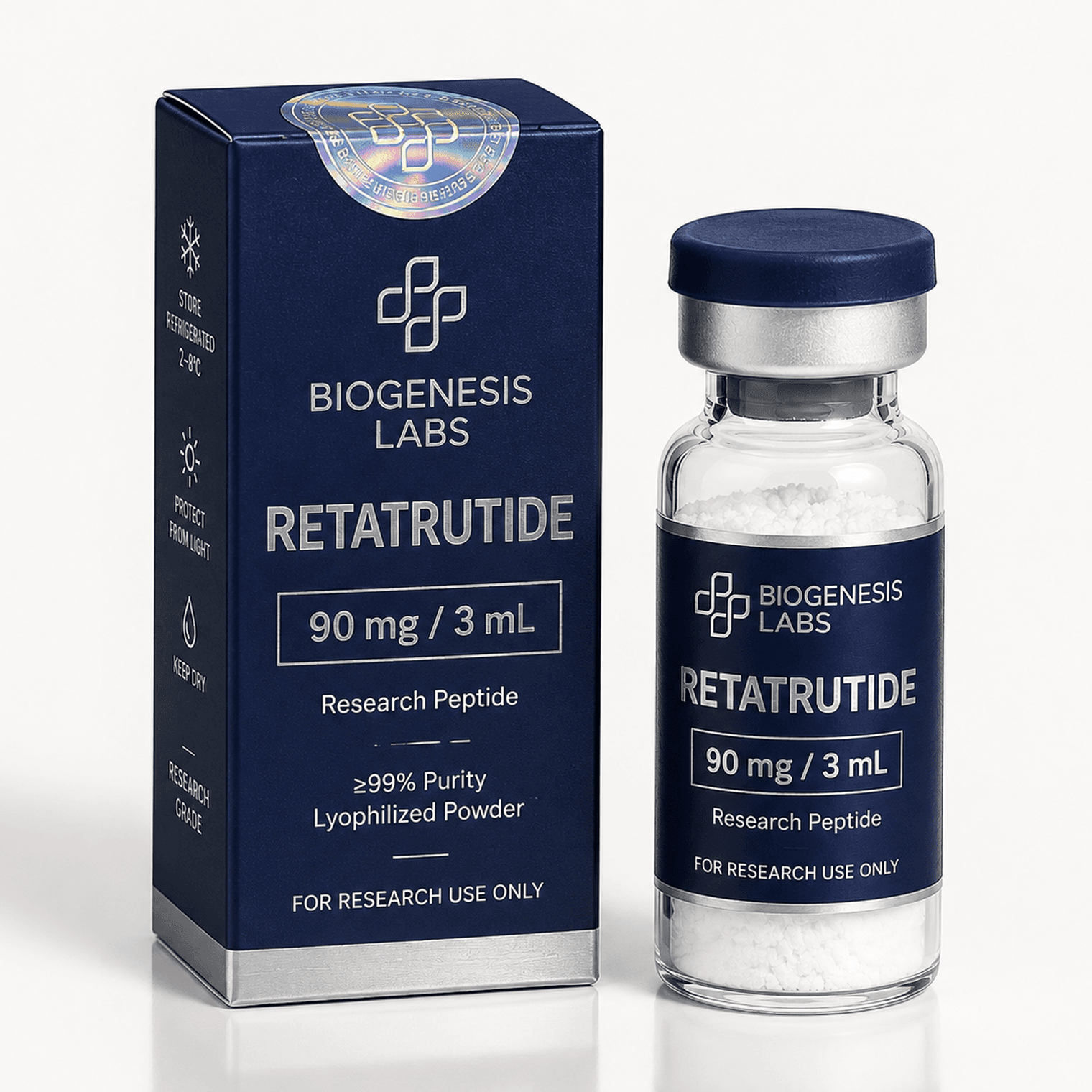
- 90 mg / 3 mL — single vial
- Purity
- ≥99%
- Form
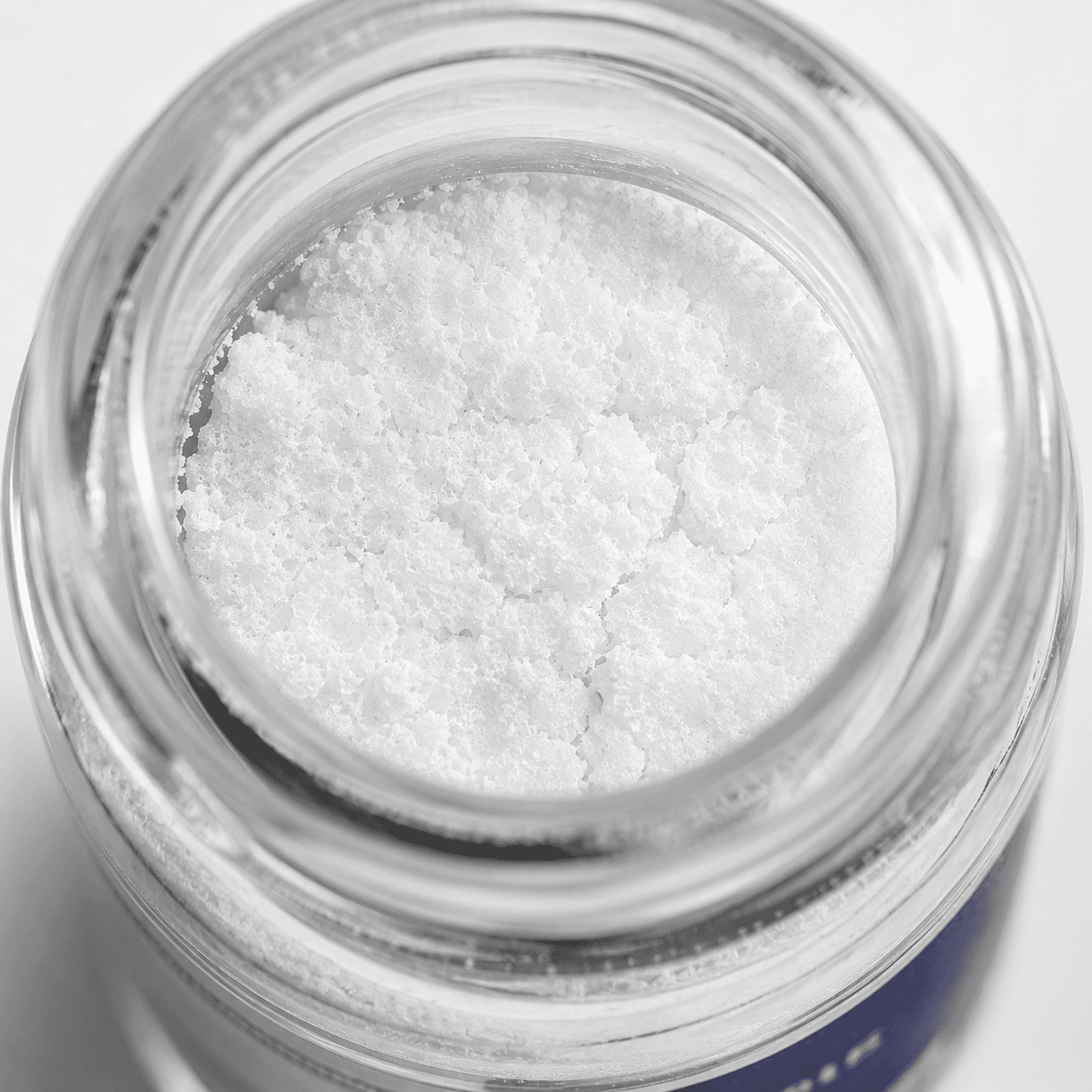
- White Lyophilized Powder
- Storage
- Refrigerated 2–8 °C. Protect from light. Keep dry
- Batch verification
- Identity and purity verified before release (HPLC/MS)
- Biogenesis platform
- Performance
- Origin
- Manufactured for Biogenesis Labs — Made in China
- Use
- FOR RESEARCH USE ONLY / NOT FOR HUMAN CONSUMPTION
We do not publish reconstitution protocols, diluents or post-reconstitution stability times: no stability data for retatrutide exists in peer-reviewed literature, and we are not going to invent it. The storage conditions stated apply to the sealed material exactly as shipped. Experimental design is the responsibility of the receiving laboratory.

The material, up close
Frequently asked questions
What a professional buyer asks
It is a synthetic lipidated peptide, development code LY3437943, described in the literature as a triple agonist of the GIP, GLP-1 and glucagon receptors. Structurally, a 39-amino-acid peptide conjugated to a C20 dicarboxylic fatty acid moiety, with a continuous helical conformation. It was developed by Eli Lilly and Company. The exact molecular weight and the full sequence are not published in the sources reviewed, so we do not report them: we would rather have a missing figure than an invented one.
It is not approved by the FDA, the EMA, ANMAT or any other regulatory agency in the world. It is an investigational compound: no authorized indication, no prescribing information, no pharmacopeial monograph. All published efficacy comes from phase 2 trials funded by the developer. Phase 3 programs are under way — TRIUMPH in obesity, obstructive sleep apnea and knee osteoarthritis; TRANSCEND-T2D-1 in type 2 diabetes — plus studies in cardiovascular disease and kidney function. Phase 3 under way is not approval.
No. This material is exclusively for in vitro and preclinical research: FOR RESEARCH USE ONLY / NOT FOR HUMAN CONSUMPTION. We do not provide doses, schedules or administration protocols, and we will not provide them if asked. Retatrutide is not approved in any jurisdiction, and the only legitimate route of human exposure today is participation in a registered clinical trial, with material supplied by the sponsor and oversight from an investigator. Any other scenario falls outside what the evidence and the law support.
Refrigerated between 2 and 8 °C, protected from light and kept dry, in its sealed vial exactly as shipped. What you will not find here are post-reconstitution stability figures, recommended diluents, pH or solubility: no published data exists on retatrutide's formulation, lyophilization or stability in peer-reviewed literature, because the compound is not approved and trial material is formulated to a proprietary, unpublished specification. Any figure of that kind in circulation comes from sellers, not from literature.
Every batch is verified for identity and purity by HPLC/MS before release, against a ≥99% specification. We are explicit about the limits of that: a certificate of analysis supplied by the seller itself is not independent verification. If your laboratory needs analytical certainty in order to publish, the correct practice is to characterize the material by your own means or through an accredited third party. The context justifies the demand: no market surveillance studies on retatrutide have been published, and that gap is itself a data point.
As a class analogy — and only as an analogy, because no equivalent data exists for retatrutide: a market surveillance study of semaglutide products sold online without a prescription measured purities between 7.7% and 14.37% against the 99% declared on the label, and classified every purchased sample as substandard and falsified medical products. That is semaglutide, not retatrutide. But it describes precisely what happens when there is no verification of identity, purity, endotoxins or synthesis impurities. With no reference monograph and no batch-level control, there is no way to know what is in the vial.
In the materials section, identify the compound by name and development code — retatrutide (LY3437943) — the supplier (Biogenesis Labs), the batch number, and the reported purity with its verification method (≥99% by HPLC/MS). We recommend stating explicitly that the material is research grade and does not come from the sponsor of the clinical program. For scientific background, cite the primary sources: Jastreboff et al. (NEJM 2023), Rosenstock et al. (Lancet 2023) and Sanyal et al. (Nature Medicine 2024) — not this page.
Professional orders
Research material,with the traceabilitythe data demands.
Retatrutide 90 mg / 3 mL. White lyophilized powder, ≥99% purity, identity and purity verified by HPLC/MS before every release. Biogenesis Labs Performance platform. Investigational compound, not approved by regulatory agencies. For in vitro and preclinical research only: not for human consumption.
Product intended exclusively for research and laboratory use. Not suitable for human consumption or for diagnostic or therapeutic use. Not evaluated by any regulatory agency. Statements describe research findings and do not constitute indications of use.